
Refractive surgery — After age 45
PresbyLASIK: laser correction of presbyopia
A laser technique that can reduce dependence on reading glasses after age 45. Assessment in Cachan: procedure at Clinique Laser Victor Hugo (Paris 16).
What is presbyopia?
Presbyopia is a natural, gradual change in vision that affects nearly everyone after age 45. The crystalline lens: the eye’s natural lens — progressively loses its elasticity and can no longer adjust for near vision. Close-up text becomes blurry, reading becomes uncomfortable, and dependence on reading glasses sets in. To understand the causes in detail and review all the solutions for presbyopia, see our dedicated page.
Presbyopia is not a disease but an inevitable physiological phenomenon. It can be combined with pre-existing myopia, hyperopia or astigmatism, which influences the choice of surgical technique.
PresbyLASIK — how it works
PresbyLASIK is an excimer laser procedure that reshapes the curvature profile of the cornea to enable functional vision at several distances. Unlike standard LASIK, which targets a single distance, PresbyLASIK creates an extended zone of sharpness. Available data show a significant improvement in both distance and near visual acuity 18 months after the procedure (Ref. PMID 25830759).
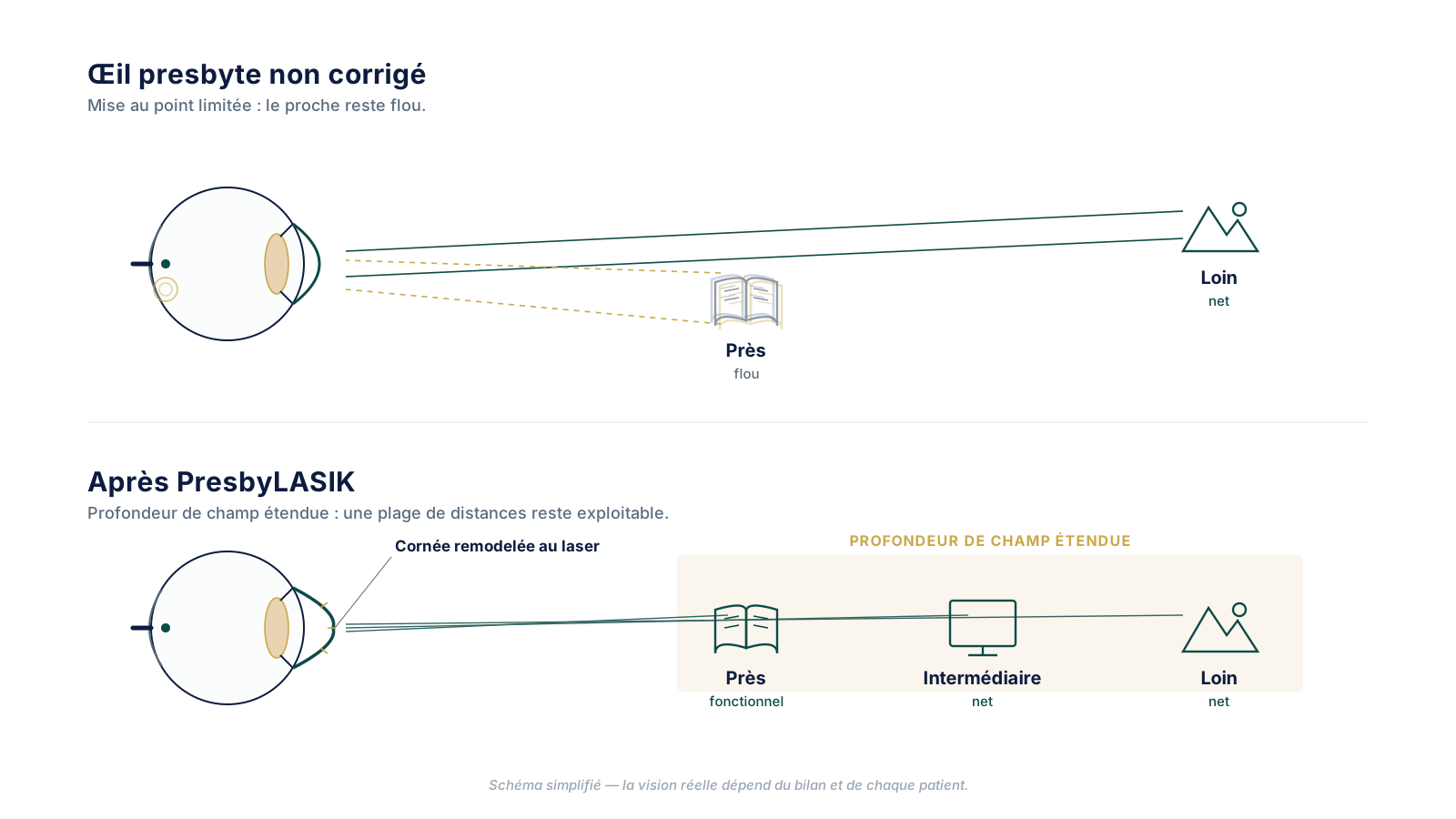
PresbyLASIK extends the depth of field to cover a range of distances, from near to far.
The techniques used at the practice
Technique 1
Monovision
Monovision involves correcting the dominant eye for distance vision and the non-dominant eye for near vision. The brain naturally selects the appropriate eye depending on the distance. This approach is supported by several clinical studies as an effective option for myopic presbyopic patients (Ref. PMID 20542487). Before any procedure, a contact-lens trial simulates monovision for one to two weeks to confirm your tolerance. This simulation can also be done at the practice using trial glasses whose lenses are swapped — a quick switch — so you can immediately feel the trade-off between distance and near vision before deciding.
Technique 2
Aspheric profile correction (Q factor)
Modifying the Q factor involves sculpting a corneal profile with an extended depth of field. Both eyes are treated symmetrically. The laser ablation is calculated to extend the range of sharpness from distance toward the intermediate-near range. This technique preserves better binocular vision but generally gives slightly less pronounced near results than monovision.
Are you a candidate?
The preoperative assessment determines whether PresbyLASIK is suited to your situation. The criteria usually required are as follows:
- Age: between 45 and 60 (beyond that, cataract surgery with a multifocal implant is often preferable)
- Cornea: thickness and topography compatible with laser ablation
- Stable refraction: prescription unchanged for at least one year
- No corneal pathology: no keratoconus, no moderate or severe dry eye
- Healthy fundus: no AMD, progressive glaucoma or other retinal pathology
- Realistic expectations: PresbyLASIK significantly reduces dependence on glasses but does not guarantee complete independence in all visual conditions
The preoperative assessment
The preoperative consultation is available at two locations:
Cachan practice: 1 Ter Rue Camille Desmoulins, 94230 Cachan — Tel. 01 45 47 08 11
Procedure — Clinique Laser Victor Hugo: 27 bis avenue Victor Hugo, 75116 Paris — Victor Hugo metro (line 2)
The assessment includes: corneal topography, pachymetry, measurement of refraction and ocular dominance, evaluation of dry eye, and examination of the fundus. If monovision is being considered, a preliminary contact-lens trial is arranged.
The procedure
PresbyLASIK is performed at the Clinique Victor Hugo (Paris 16). The procedure takes 15 to 20 minutes for both eyes and is performed on an outpatient basis. Visual recovery is gradual: functional vision within 24 to 48 hours for a LASIK approach, 7 to 10 days when a PKR procedure is combined.
Expected results and limitations
In a series of 37 patients followed one year after bi-aspheric PresbyLASIK, the subjective satisfaction score reached 93±8 (Ref. PMC7013778). These results should be placed in context: satisfaction depends closely on patient selection and on the quality of the preoperative assessment.
Limitations to be aware of: a slight reduction in night-time contrast is possible; near vision may remain insufficient for very fine print in low light; and presbyopia can progress with age and require a touch-up later (Ref. PMID 28413804).
PresbyLASIK or a multifocal implant?
Two routes can reduce dependence on glasses after age 45. PresbyLASIK reshapes the cornea with a laser; the multifocal implant replaces the crystalline lens. The choice depends mainly on age and on the condition of the crystalline lens:
| Criterion | PresbyLASIK | Multifocal implant |
|---|---|---|
| Principle | Laser reshaping of the cornea | Replacement of the crystalline lens with an implant |
| Typical age | ~45–58, clear crystalline lens | ~58 and older, or early cataract |
| Crystalline lens | Preserved | Replaced (eliminates the risk of later cataract) |
| High refractive errors | More limited indications | Suited to large corrections |
| Permanence | Touch-up possible later | Permanent |
Neither option is universal. In a still-young patient with a clear crystalline lens, the laser is often preferred; after age 60, or in the case of an early cataract, the multifocal implant generally becomes more relevant. Only the preoperative assessment can decide, based on your age, your refractive error and your lifestyle.
Price and coverage
PresbyLASIK is offered at €3,500 for both eyes, as an all-inclusive package covering the procedure and the follow-up consultations during the first month. Like all refractive surgery, it is a non-reimbursable procedure: it is not covered by the French national health insurance (Assurance maladie). Many private health plans (mutuelles) do, however, offer a “refractive surgery” allowance; remember to check your policy. A detailed quote is provided at your preoperative assessment, and the breakdown of prices by technique is listed on the dedicated page.
Frequently asked questions
Can PresbyLASIK correct presbyopia and myopia at the same time?
Yes, in the vast majority of cases. It is in fact the most common indication: the myopic patient who has recently started wearing reading glasses. The ablation calculation incorporates the correction of both myopia and presbyopia at the same time.
After age 60, is PresbyLASIK still indicated?
After age 60, the crystalline lens often begins to show signs of an early cataract. In that case, cataract surgery with a multifocal or EDOF implant is generally more appropriate than the laser. The preoperative assessment determines which option matches your situation.
Is the procedure covered by insurance?
PresbyLASIK is an elective procedure, outside the standard fee schedule: it is not reimbursed by the French national health insurance (Assurance maladie). Some private health plans (mutuelles) offer partial coverage. A quote is provided at the preoperative consultation.
Is the result of PresbyLASIK permanent?
The laser reshapes the cornea permanently. However, presbyopia is linked to the natural ageing of the crystalline lens, which continues over time: a correction obtained at age 50 may therefore evolve over the years. A touch-up, or occasional use of glasses for certain tasks, remains possible. This point is discussed in detail at the preoperative assessment.
Is an adaptation period needed after the procedure?
Yes. Presbyopia correction techniques (monovision, aspheric profile) require the brain to go through a neuroadaptation phase, from a few weeks to a few months, in order to combine the images from both eyes. This adaptation is generally well tolerated; a preliminary contact-lens trial may be offered at the assessment to anticipate it.
What side effects can occur?
As with all refractive surgery, PresbyLASIK can be accompanied by temporary dry eye, halos or increased sensitivity to light at night, and a slight decrease in contrast sensitivity related to the multifocal principle. These phenomena are most often temporary and ease with neuroadaptation. All the possible adverse effects are explained to you during the consultation.
Scientific references
1. Vargas-Fragoso V, Alió JL. Corneal compensation of presbyopia: PresbyLASIK: an updated review. Eye Vis (Lond). 2017;4:11. PMID 28413804
2. Soler Tomás JR, Fuentes-Páez G, Burillo S. Symmetrical Versus Asymmetrical PresbyLASIK: Results After 18 Months and Patient Satisfaction. Cornea. 2015;34(6):651–657. PMID 25830759
3. Garcia-Gonzalez M, Teus MA, Hernandez-Verdejo JL. Visual outcomes of LASIK-induced monovision in myopic patients with presbyopia. Am J Ophthalmol. 2010;150(3):381–386. PMID 20542487
4. Liu F, Zhang T, Liu Q. One year results of presbyLASIK using hybrid bi-aspheric micro-monovision ablation profile in correction of presbyopia and myopic astigmatism. Int J Ophthalmol. 2020;13(2):271–277. PMID 32090037
Eligibility assessment
Book an appointment
Consultation available in Cachan (94). Procedure at Clinique Victor Hugo, Paris 16.
Further reading
- LASIK surgery — the principle of corneal laser treatment, here applied to presbyopia.
- Cataract surgery — multifocal implants also correct presbyopia.
- Am I eligible? — check your profile in 2 minutes.
- Preoperative assessment — the full examination performed before any decision.
- Refractive surgery pricing — the breakdown of prices by technique.
Written and medically reviewed by Dr Moïse Tourabaly, ophthalmologist — former chief resident (Quinze-Vingts National Eye Hospital). Last updated: July 6, 2026