
Refractive surgery
LASIK in Paris and Cachan: Laser Refractive Surgery | Dr Tourabaly
Lasting laser correction of myopia, hyperopia and astigmatism. A 15-minute procedure, with recovery within 24 to 48 hours. Personalised assessment at the Cachan office.
Unsure which technique is right for you? LASIK or SMILE or LASIK or PKR — our detailed comparisons cover safety, recovery, dry eye, sport and pricing.
UNDERSTANDING LASIK
What is LASIK? Principle and mechanism
LASIK (short for Laser-Assisted In situ Keratomileusis) is a laser refractive surgery technique. It aims to correct refractive errors durably by reshaping the cornea: the transparent membrane on the surface of the eye. The goal is to let the patient see clearly without glasses or contact lenses.
LASIK relies on two successive laser steps, performed in a single session and on both eyes the same day. The surgeon first creates a thin corneal layer: known as the flap: using a precision femtosecond laser. This flap, about 100 microns thick, is gently lifted to expose the deeper corneal tissue.
The second laser, called the excimer laser, then sculpts the cornea according to the exact profile of the refractive error to be corrected, calculated to within a micron during the pre-operative work-up. The flap is then laid back down without sutures: it adheres naturally within a few minutes. The complete procedure lasts about 15 minutes for both eyes, under local anaesthesia with eye drops.
LASIK is today the most widely performed refractive surgery technique in the world, with more than twenty-five years of clinical experience behind it. Current laser generations: in particular topography-guided protocols (TG-LASIK): deliver unrivalled correction precision, especially for demanding patients.
Which vision problems does LASIK correct?
LASIK surgery can treat the main refractive errors of the eye:
- Myopia: blurred distance vision, clear near vision. LASIK corrects mild, moderate and high myopia, generally up to -8 to -10 dioptres depending on corneal thickness.
- Hyperopia: blurred near vision, sometimes blurred distance vision too with age. LASIK corrects hyperopia up to around +5 dioptres.
- Astigmatism: distorted, doubled or imprecise vision at all distances. LASIK corrects astigmatism up to 5 dioptres, whether isolated or combined with myopia or hyperopia.
- Presbyopia: difficulty seeing up close after the age of 45. A variant called PresbyLASIK can restore intermediate and near vision without glasses.
Beyond these dioptre limits, other techniques may be offered: PKR for thin corneas, SMILE for a less invasive approach, or phakic implants for very high myopia.
Who is LASIK suitable for?
LASIK is elective surgery: it does not treat a disease but improves quality of life. The indications must therefore be carefully assessed during a full pre-operative work-up, which determines whether the patient is an anatomically and medically suitable candidate for this technique.
Indications (ideal candidate)
- Age 21 or over, ideally with a stable refraction for at least two years (no change greater than 0.5 dioptre over the past year).
- Cornea of sufficient thickness and regular curvature, measured by corneal topography and pachymetry during the work-up.
- Refractive error within correctable limits: myopia up to -8/-10 D, hyperopia up to +5 D, astigmatism up to 5 D.
- Good general eye health: no severe dry eye, no corneal disease (keratoconus in particular) or progressive retinal condition.
- Clear motivation and realistic expectations, after full information on the benefits and limits of the procedure.
Contraindications
LASIK is not suitable for every profile. The main contraindications are:
- A cornea that is too thin or shows early signs of keratoconus (progressive corneal deformation).
- Severe dry eye not controlled by treatment.
- Unstable refraction, still changing (young patients whose vision is still developing, recent hormonal changes).
- Current pregnancy or breastfeeding (hormonal variations may alter the refraction and the operating conditions).
- Active systemic conditions: poorly controlled autoimmune diseases, unbalanced diabetes, immunosuppressive treatments.
- Eye history: recurrent ocular herpes, uncontrolled glaucoma, progressive cataract (in which case cataract surgery with a premium implant is generally preferable).
If LASIK is not indicated in your case, other refractive surgery techniques can be considered and will be assessed during the pre-operative work-up.
HOW THE PROCEDURE WORKS
How does a LASIK procedure work?
The patient pathway follows a rigorous protocol in three stages: a thorough pre-operative work-up at the office, the procedure in the operating theatre, then the recovery phase with close follow-up. Each stage shapes the quality of the final result.
Surgical video · Dr Tourabaly‘s practice
Cutting the corneal flap with the Zeiss VisuMax 800 femtosecond laser
A key step of LASIK: 8 seconds of real procedure, captured on the screen of the VisuMax 800 platform (Carl Zeiss Meditec). The timer counts down from 8s to 0s while the femtosecond laser cuts a circular corneal flap about 100 microns thick.
Step 1: The pre-operative work-up
The pre-operative work-up is an essential step: it determines whether LASIK is indicated and how precise the result will be. It is carried out exclusively at the Cachan office (94), where the high-precision corneal measurement equipment is located: topography, pachymetry, aberrometry, dynamic pupil measurement. To book an appointment, contact the office on 01 45 47 08 11 or via Doctolib.
The appointment lasts about 30 minutes. In some cases: checking for the absence of overcorrection, a thorough examination of the fundus: a second appointment may be needed after instilling a cycloplegic eye drop (Skiacol). This step is not systematic and depends on your clinical profile.
Before the work-up, stopping contact lenses is essential to allow the cornea to return to its natural shape:
- Soft lenses: 24 to 48 hours before the appointment
- Rigid lenses: 3 to 5 days before
At the end of the work-up, Dr Tourabaly determines whether you are a candidate for LASIK and, where applicable, calculates the correction parameters to within a micron. For more detail on the examinations performed, see the dedicated pre-operative work-up page.
Step 2: The day of the procedure
The procedure is performed at the Clinique Laser Victor Hugo, in the 16th arrondissement of Paris. Allow about 1 hour on site: preparation, pre-operative checks, the procedure itself, then an immediate post-operative review. The procedure is outpatient: no hospital stay is required.
The procedure is carried out under local anaesthesia with the instillation of anaesthetic eye drops. No injection, no drip: you remain conscious, and you are simply asked to fix your gaze on a light for a few seconds at each laser step. The procedure lasts 15 to 20 minutes for both eyes.
Immediately after LASIK, Dr Tourabaly carries out a slit-lamp examination to check that the corneal flap is correctly positioned. You then leave the clinic with vision still blurred for 2 to 4 hours: a companion is essential for the journey home.
Dr Tourabaly’s LASIK procedures are generally performed on Thursdays at the Clinique Laser Victor Hugo. This regularity lets patients plan their time off with peace of mind: LASIK on Thursday, day-1 check-up on Friday at the Cachan office, then a weekend of rest at home.
Step 3: Recovery and follow-up
The day after the procedure, a mandatory day-1 check-up at the Cachan office allows the initial healing to be verified and the eye-drop treatment to be adjusted if needed. Functional vision is usually regained within 24 hours, enough for reading, screen use and driving. Full visual stabilisation then takes place over 1 to 3 months depending on the patient.
It is advisable to plan 2 to 3 days off for a comfortable recovery. As LASIK is elective surgery, it does not give rise to sick leave prescribed by the French national health service.
During the first few weeks, certain precautions are essential to protect the result:
- Do not rub your eyes (risk of displacing the flap)
- Avoid squeezing the eyelids tightly
- Apply the antibiotic and anti-inflammatory eye drops strictly as prescribed
- No swimming pool, eye make-up, sauna or contact sport for about 15 days
A follow-up at 1 month, 3 months and 1 year is then offered to confirm the stability of the result.
CLINICAL RESULTS
Expected results and effectiveness of LASIK
LASIK is today one of the best-documented surgical procedures in the world, with more than twenty-five years of clinical experience and an abundant body of scientific literature.
LASIK surgery in 5 steps
The gold-standard femtosecond laser technique, performed under anaesthetic eye drops, fast and suture-free.
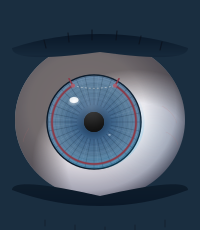 1
1Creating the corneal flap
⏱ ~8 secondsA thin corneal layer is cut with the Visumax 800 femtosecond laser, with micrometric precision.
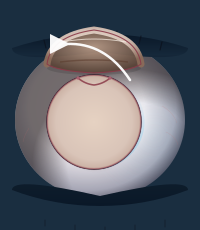 2
2Lifting the flap
⏱ ~10 secondsThe flap is gently lifted to expose the underlying corneal stroma.
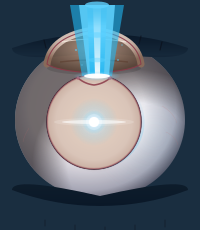 3
3Reshaping the cornea
⏱ ~60 secondsThe excimer laser sculpts the cornea to correct the refractive error, under anaesthetic eye drops.
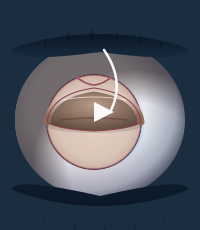 4
4Repositioning the flap
⏱ ~30 secondsThe flap is repositioned precisely, with immediate natural adhesion and no sutures.
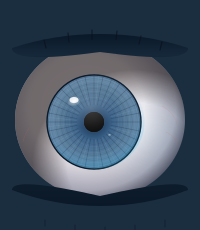 5
5Corrected eye
✓ Healing in 24 hClear, stable vision from the next day, with a fast and comfortable recovery.
Chirurgie réfractive · LASIK
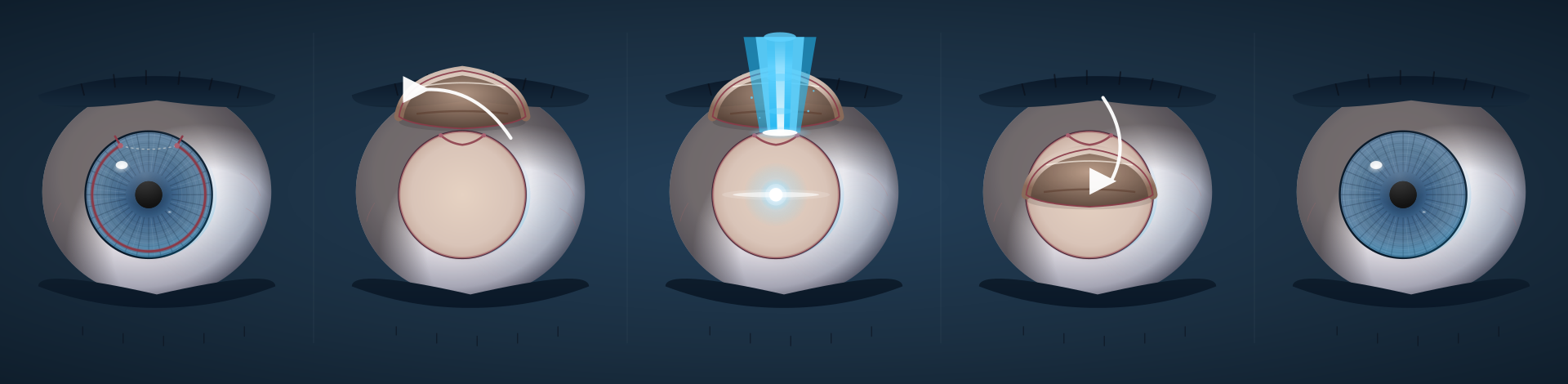
Le LASIK, étape par étape
-
Creating the corneal flap
⏱ ~ 8 secondsA thin corneal layer is cut with the Visumax 800 femtosecond laser, with micrometric precision.
-
Lifting the flap
⏱ ~ 10 secondsGentle opening from the upper hinge, exposing the stroma.
-
Reshaping the cornea
⏱ ~ 60 secondsExcimer laser: sculpting the stroma according to the visual correction.
-
Repositioning the flap
⏱ ~ 30 secondsThe flap is laid back onto the reshaped cornea, without sutures.
-
Corrected eye
⏱ Healing in 24 hNatural adhesion, fast healing, restored vision.
Sandoval 2016 (67,893 eyes)
PROWL FDA studies 2017
since 1999
According to the reference meta-analysis published in the Journal of Cataract and Refractive Surgery by Sandoval et al. in 2016, which analysed the outcomes of 67,893 eyes treated with LASIK across 97 international studies, 99.5% of eyes achieve an uncorrected visual acuity better than 20/40: the legal threshold for a driving licence, and 98.6% fall within ±1.0 dioptre of the refractive target.
A recent review of the scientific literature published in 2025 adds detail on high-resolution vision: with topography-guided LASIK (TG-LASIK): a cutting-edge technique that Dr Tourabaly performs: 91.8% of myopic patients achieve 20/20 without glasses or contact lenses (very sharp vision), and 95% of treated eyes fall within ±0.50 dioptre of the targeted correction.
In terms of subjective satisfaction, the figures converge: Sandoval reports 98.8% of satisfied patients, and the PROWL studies, conducted jointly by the FDA, the National Eye Institute and the US Department of Defense and published in JAMA Ophthalmology in 2017, reported 96% to 99% patient satisfaction across two separate cohorts (dissatisfaction rates of 1% to 4% depending on the question).
These results nonetheless reflect statistical averages. Every case is individual: only a full pre-operative work-up can accurately estimate the result you can expect.
Post-operative course and recovery
The speed of recovery is one of the distinctive features of LASIK compared with other refractive surgery techniques such as PKR.
The usual post-operative timeline is as follows:
- Evening of day 0: blurred vision, watering eyes, a gritty sensation, light sensitivity. Resting in a dimly lit room is recommended.
- Day 1: mandatory check-up at the Cachan office. Vision is often already useful for everyday activities (reading, screen use). Dr Tourabaly explains at the check-up when you can resume driving, generally within 2 to 3 days depending on your individual recovery.
- Days 2 to 7: gradual improvement. Dry eye is common, treated with artificial tears.
- Weeks 1 to 4: visual stabilisation, with possible night-time halos in low light.
- Months 1 to 3: complete refractive stabilisation in most patients.
The antibiotic and anti-inflammatory eye drops must be applied strictly as prescribed. Resuming activities follows these guidelines:
- Screen work: 48 to 72 hours
- Light sport: 1 week
- Swimming, contact sports, sauna: 2 to 3 weeks
- Eye make-up: 2 weeks
Medical follow-up includes a mandatory check-up at day 1, then at 1 month, 3 months and 1 year, to document the stability of the result.
FAIR INFORMATION
Possible risks and complications
No surgery is free of risk, and giving the patient fair information about these risks is an integral part of the pre-operative consultation.
Transient side effects (common, mild)
- Dry eye for 1 to 3 months, treated with artificial tears
- Night-time halos and glare, most often transient
- Slight visual fluctuations in the first few weeks
- Transient light sensitivity in the first few days
Rare complications worth knowing about
- Flap folds (about 0.73% of cases): treatable by early repositioning, most often within 48 hours
- Diffuse lamellar keratitis: a benign inflammation of the flap interface, resolving with intensive anti-inflammatory treatment
- Undercorrection or overcorrection: a laser enhancement may be offered after 3 to 6 months of stability
- Corneal infection: exceptional with current post-operative protocols
- Corneal ectasia: a rare progressive deformation (estimated between 0.04% and 0.6% depending on the studies), whose risk is minimised by a rigorous pre-operative work-up including topography and pachymetry
The safety figures in context
Statistically, the 2025 review in the Journal of Refractive Surgery reports a rate of serious (sight-threatening) complications of 0.07%, fewer than one case per thousand procedures. The Sandoval meta-analysis covering 67,893 eyes shows a loss of 2 or more lines of visual acuity in only 0.61% of cases. The US PROWL studies indicate that fewer than 1% of patients report significant difficulties in their daily activities after LASIK.
In all transparency: no surgery is without risk, but LASIK ranks among the safest and best-documented elective procedures in modern medicine, provided candidates are rigorously selected during the initial work-up. This is why the pre-operative work-up at the Cachan office is so thorough: identifying contraindications early remains the key element of patient safety. For the full picture of the data, see our dedicated page on the safety of refractive surgery.
LASIK vs PKR vs SMILE: how to choose?
LASIK is not the only refractive surgery technique available. PKR and SMILE meet specific indications. Understanding the main differences helps guide the discussion during the pre-operative work-up.
Coupe transversale de cornée
Comparaison du geste chirurgical — LASIK et SMILE
LASIK
SMILE
Principle: creating a corneal flap with the femtosecond laser, then sculpting with the excimer laser.
Indications: myopia ≤ -10 D, hyperopia ≤ +5 D, astigmatism ≤ 5 D, cornea of sufficient thickness.
Recovery: useful vision within 24 h, stabilisation over 1 to 3 months.
Notable features: high post-operative comfort, fast recovery.
Principle: direct sculpting of the corneal surface (no flap). See the PKR page.
Indications: thin corneas, occupations with a risk of eye trauma (contact sports, military personnel).
Recovery: useful vision from day 4 (removal of the bandage lens), stabilisation over 1 to 3 months.
Notable features: no flap (eliminates the risk of folds), more uncomfortable in the first few days.
Principle: extraction of a corneal lenticule through a micro-incision (no full flap). See the SMILE page.
Indications: myopia ≤ -10 D, moderate astigmatism, patients wanting a minimally invasive approach.
Recovery: useful vision within 24-48 h.
Notable features: better preserves corneal innervation (less dry eye), not indicated for hyperopia.
A note on PKR: in Dr Tourabaly’s practice, the bandage lens protecting the cornea during healing is removed on the Monday after the procedure (i.e. day 4). As soon as this lens is removed, vision is often already clear, better than the uncorrected vision before surgery, even though full stabilisation takes 1 to 3 months.
The final choice depends on your corneal anatomy, your work and sporting activities, and your clinical profile. The pre-operative work-up determines the technique best suited to your case. For very high myopia beyond the limits of the laser, the phakic implant can be an alternative.
Where do the procedure and consultations take place?
The surgery: Clinique Laser Victor Hugo (Paris 16)
The LASIK procedure is performed in the operating theatre of the Clinique Laser Victor Hugo, located in the 16th arrondissement of Paris.
This facility has the most recent technical equipment in refractive surgery: the Zeiss VisuMax 800 (latest-generation femtosecond laser) and the Schwind Amaris 750S (high-frequency 750 Hz excimer laser).
Procedures are generally performed on Thursdays.
Pre-operative consultations and follow-up: the Cachan office (94)
The pre-operative work-up and all the post-operative check-ups (day 1, month 1, month 3, month 12) take place at the Cachan office: 1 Ter Rue Camille Desmoulins, 94230 Cachan, telephone 01 45 47 08 11. Easy access by RER B (Bagneux station, a 5-minute walk away, and Arcueil-Cachan, 10 minutes away).
The Paris 13 office: ocular diabetology and retina only
Dr Tourabaly’s Paris office is located at 12 Rue du Moulin des Prés, 75013 Paris, telephone 01 89 31 30 60. The consultations provided there cover general ophthalmology and specialist care for diabetes and the retina. LASIK pre-operative work-ups are carried out only at the Cachan office, which has the high-precision corneal measurement equipment. Patients living in Paris 13 can reach Cachan in about 20 minutes via the RER B.
Pricing and cover
LASIK surgery is an elective procedure and is not reimbursed by the French national health service. Prices vary according to the technique chosen (standard LASIK, topography-guided LASIK, PresbyLASIK) and the complexity of the correction required.
Many complementary health insurers offer a fixed contribution towards refractive surgery. It is advisable to check your policy or to ask your insurer directly about any amount available.
A personalised, detailed quote is given to you at the end of the pre-operative work-up, based on the technique chosen for your case. For more detail on indicative prices for the various procedures, see the refractive surgery pricing page.
SURGICAL EXPERTISE
Why choose Dr Tourabaly for your LASIK
The choice of surgeon is an important decision in refractive surgery. A few factual pointers about Dr Tourabaly’s background and approach can help inform that decision.
Academic background
Former Chef de Clinique at the Quinze-Vingts National Ophthalmology Hospital (Paris), Sorbonne University.
Surgical specialisation
Regular practice of LASIK, PKR, phakic implants for high myopia, and cataract surgery with premium implants.
Technology used
Zeiss VisuMax 800 femtosecond laser and Schwind Amaris 750S excimer laser at the Clinique Laser Victor Hugo, two latest-generation systems that enable high-precision topography-guided LASIK.
Patient approach
A thorough pre-operative work-up, transparent information on both the benefits and the limits and risks of the procedure, and personalised follow-up for up to a year after surgery.
Patient reviews
More than 1,000 Google reviews for the Cachan office, with an average rating of 4.9/5.
To find out more about Dr Tourabaly’s background and qualifications, see the full profile page.
PATIENT TESTIMONIALS
Reviews from LASIK patients
Genuine reviews published on Google Maps: more than 1,000 reviews · 4.9/5.
After a LASIK procedure to correct my myopia, I can say two months on that the result is more than convincing. A big thank you to Dr Tourabaly, who supported me really well; he took the time to explain how the procedure would go, which allowed me to approach it calmly. Very professional, conscientious and patient 👍
I had myopia surgery three weeks ago now using the LASIK technique. Dr Tourabaly is attentive and explains things very clearly. The procedure went very well, as did the follow-up before and after. I highly recommend him.
I had LASIK refractive surgery with Dr Tourabaly. He takes the time to explain the procedure clearly and listens to every question. I recommend him.
Quick and efficient care for myopia surgery by LASIK. I recommend him.
A great experience, a very professional practice and honestly a really pleasant welcome at reception, a surgeon who takes his time and calls you the day after your procedure. Now I live without glasses and I am more than happy, thank you again.
FAQ
Frequently asked questions about LASIK
Book an appointment for a LASIK assessment
The pre-operative work-up is the essential step before any decision. It checks your eligibility for LASIK, discusses the techniques suited to your profile, and answers all your questions. Book your consultation at the Cachan office in just a few clicks.
A no-obligation consultation: the pre-operative work-up determines whether LASIK is suitable for your case.
You can also contact the offices directly:
- Cachan office (94): 1 Ter Rue Camille Desmoulins, 94230 Cachan: 01 45 47 08 11: LASIK pre-operative work-ups and all consultations.
- Paris 13 office (75013): 12 Rue du Moulin des Prés, 75013 Paris: 01 89 31 30 60: ocular diabetology and retina only.
Scientific sources
- Sandoval HP, Donnenfeld ED, Kohnen T, Lindstrom RL, Potvin R, Tremblay DM, Solomon KD. Modern laser in situ keratomileusis outcomes. J Cataract Refract Surg. 2016;42(8):1224-34. PubMed
- Eydelman M, Hilmantel G, Tarver ME, et al. Symptoms and Satisfaction of Patients in the Patient-Reported Outcomes With Laser In Situ Keratomileusis (PROWL) Studies. JAMA Ophthalmology. 2017;135(1):13-22. PMID 27893066.
- Laser in Situ Keratomileusis Outcomes and Complications: 2016 to 2023. J Refract Surg. 2025. PubMed
📍 LASIK consultations also available in Paris 13: Cabinet Diabet’, 12 Rue du Moulin des Prés. Find out more →
Written and medically reviewed by Dr Moïse Tourabaly, ophthalmologist — former chief resident (Quinze-Vingts National Eye Hospital). Last updated: July 6, 2026
Patient questions
Each answer is written and verified by Dr Tourabaly as general information. It does not replace a consultation.