Break free from glasses with full safety
Refractive and cataract surgeon in Paris & Cachan: LASIK, PRK, phakic implant, cataract.
Book an appointment Doctolib · Cachan & Paris Eligibility test · 2 minView pricingChief Resident
Corneal research
Française des Yeux
Diploma
& Cataract Surgery
What would you like to correct ?
Identify your vision disorder to discover the surgical techniques that may correct it, then confirm your eligibility during a pre-operative assessment.
Myopia
Blurred distance vision, clear up close. Depending on the degree and the cornea : LASIK, PRK, SMILE or ICL implant.
Learn moreAstigmatism
Distorted or doubled vision at all distances. Corrected with laser treatment or a toric implant.
Learn moreHyperopia
Constant visual effort, fatigue especially up close. Corrected with hyperopic LASIK or an implant.
Learn morePresbyopia
Difficulty reading up close after age 45. Options : PresbyLASIK or multifocal implants.
Learn moreA technique tailored to each eye
No single technique suits everyone. After a complete pre-operative assessment (topography, aberrometry, pachymetry), Dr Tourabaly determines the solution best suited to your anatomy and your lifestyle.
Femtosecond LASIK
Correction with femtosecond and excimer lasers. Visual recovery within 24 to 48 hours. Indications: myopia, hyperopia, astigmatism.
Learn morePRK / Trans-PRK
Surface ablation with no corneal flap. Indicated for thin corneas, contact sports and certain high-risk professions.
Learn moreSMILE
An all-femtosecond-laser technique with a 2 mm mini-incision. Less impact on the corneal nerves, hence less post-operative dryness.
Learn morePhakic implant (ICL)
An intraocular lens placed in front of the natural lens. Reversible. Indicated for high myopia beyond −8 diopters or corneas too thin for laser surgery.
Learn morePresbyopia
PresbyLASIK, monovision, multifocal or EDOF implants. A personalized solution based on your age, refractive error and visual habits.
Learn moreEligibility test
A quick 2-minute questionnaire to find out whether you are a candidate for refractive surgery.
Start the testRegain clear vision, free of glasses if you wish
A cataract is a progressive clouding of the natural lens. The procedure replaces the lens with an intraocular implant chosen together with you according to your visual needs.
- Monofocal implants: covered by French national health insurance
- EDOF implants (Symfony, Vivity): distance + intermediate vision
- Multifocal implants (PanOptix): vision at all distances
- Toric implants: simultaneous correction of astigmatism
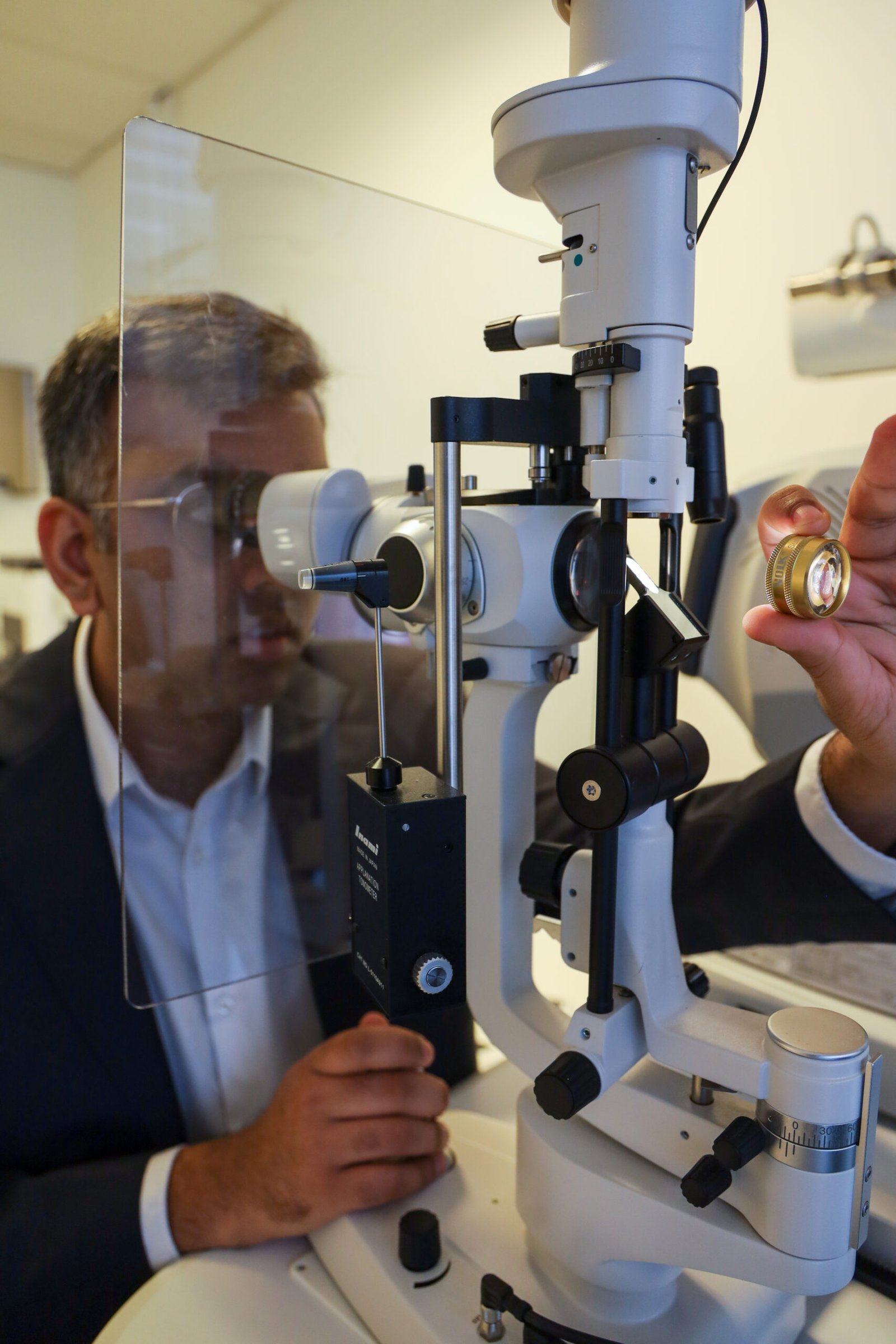
Medical ophthalmology
Retinal conditions, diabetes and specialized follow-up
Dr Tourabaly’s practice extends beyond refractive and cataract surgery. At the Paris 13 · Diabet’ practice, a hub dedicated to diabetic patients and retinal conditions, he provides screening, medical follow-up and surgical management of the main disorders of the fundus, the retina and the optic nerve.
Diabetic retinopathy
Screening and treatment: intravitreal injections, panretinal laser. Annual monitoring is recommended for every diabetic patient.
Learn moreAMD
Diagnosis and management of macular degeneration (dry or wet form). Cirrus 6000 OCT + TowardPi OCT-A, anti-VEGF injections.
Learn moreRetinal detachment & ERM
Vitreoretinal surgery: vitrectomy for retinal detachment, epiretinal membrane, macular hole. Emergency management when needed.
Learn moreGlaucoma
Screening (eye pressure, HFA3 visual field, optic nerve OCT) and follow-up. Medical treatment or SLT laser depending on the stage.
Learn more🏥 Paris 13 · Diabet’ practice
These consultations are mainly carried out at the specialized Paris 13 hub, equipped with a 200° ultra-widefield Optos, a Toward Pi YAlkaid OCT and a Quantel laser (SLT / YAG / Argon). Accessible by metro line 7 / tram T3.
See the Paris 13 practice →A structured protocol, from consultation to follow-up
Initial consultation
Complete examination, review of your needs, study of your visual history and your habits.
Pre-operative assessment
Corneal topography, aberrometry, pachymetry, OCT. Selection of the suitable technique.
Procedure
Outpatient procedure, nearly painless under local anesthesia. Duration: 10 to 30 minutes depending on the technique.
Post-operative follow-up
Consultations on D1, D7, M1 and M3. Long-term check-ups recommended annually.
Rigorous, personalized and transparent care
Hospital and university training
Former Chief Resident at the XV-XX National Eye Hospital, trained at Sorbonne University.
Complete pre-operative assessment
Topography, aberrometry, pachymetry, OCT: every indication is confirmed by detailed mapping of your cornea.
Current technologies
Femtosecond laser, excimer, SMILE, EDOF and toric implants. Technologies validated by the HAS and learned societies.
Verified patient feedback
Average rating 4.9/5 across over 1,000 reviews published on Google. See the testimonials → · View on Google Maps →
Two accessible practices
Cachan (RER B · 15 min from Paris Châtelet) and Paris 13 (line 7 / tram T3). Care made easier depending on what is closest to you.
Pricing transparency
Clear prices shown before any commitment. No sales pressure: surgery is only offered when it is genuinely appropriate.
What our patients say
After LASIK surgery to correct my myopia, I can say two months on that the result is more than convincing. A big thank you to Dr Tourabaly, who looked after me very well; he took the time to explain how the operation would unfold so I could go into it with peace of mind. Very professional, conscientious and patient 👍
I’m writing 3 days after my refractive PRK surgery performed by Doctor Tourabaly. Everything went smoothly, and everything was clear from start to finish. My eyesight is better than I expected. If you have a job where glasses get in the way, this operation will change your life.
Excellent surgeon. I had retinal detachment surgery in each eye and cataract surgery in both eyes as well, that is 4 fully successful operations over 2 years. He has just operated on a secondary cataract with the laser, very successfully. I wholeheartedly recommend Doctor Tourabaly, in whom I have complete confidence.
I had myopia surgery 3 weeks ago now using the LASIK technique. Dr Tourabaly listens and explains things very well. The operation went very smoothly, and so did the follow-up before and after. I recommend him wholeheartedly.
I highly recommend Dr Tourabaly, whom I trusted for refractive PRK surgery for my myopia. Very professional and attentive to the patient.
Excellent surgeon, very attentive and available. No pain during or after the cataract surgery. I regained excellent vision thanks to the multifocal implants. I recommend him to you without hesitation.
The ones that come up most often
Am I a candidate for refractive surgery?
Is laser surgery painful?
When can I go back to work after LASIK?
How much does the surgery cost? Is it reimbursed?
How many consultations are needed?
Is the correction permanent?
What is the difference between LASIK, PRK and SMILE?
Discuss your vision goals
The first consultation lets us check your eligibility, discuss the available techniques and answer all of your questions.