The diopter: definition, prescription and refractive surgery
The diopter is the international unit that measures the power of a lens or a visual defect. It is the number that appears on your glasses prescription, preceded by a minus sign for myopia and a plus sign for hyperopia. Understanding what a diopter represents helps you read your prescription, gauge the severity of your refractive error and discuss your correction options with your ophthalmologist with confidence.
UNDERSTANDING
What is a diopter?
The diopter is the unit used to measure the optical power of a lens, whether it is a spectacle lens, a contact lens or the eye’s own crystalline lens. It is written with the symbol δ or, more commonly on prescriptions, with the letter D.
In physical terms, one diopter corresponds to the inverse of the focal length expressed in metres. A lens whose focal point lies one metre away has a power of 1 diopter; if that focal point is at 50 centimetres (0.5 m), the power rises to 2 diopters. The more sharply a lens converges light over a short distance, the higher its power in diopters.
Applied to the human eye, this unit measures the corrective power required to bring a sharp image exactly onto the retina. The eyeball is itself an optical system of roughly 60 diopters, combining the cornea (about 43 δ) and the crystalline lens (about 17 δ). Refractive errors — myopia, hyperopia, astigmatism — arise when this total power is slightly out of step with the axial length of the eye.
PRESCRIPTION
How do you read your prescription in diopters?
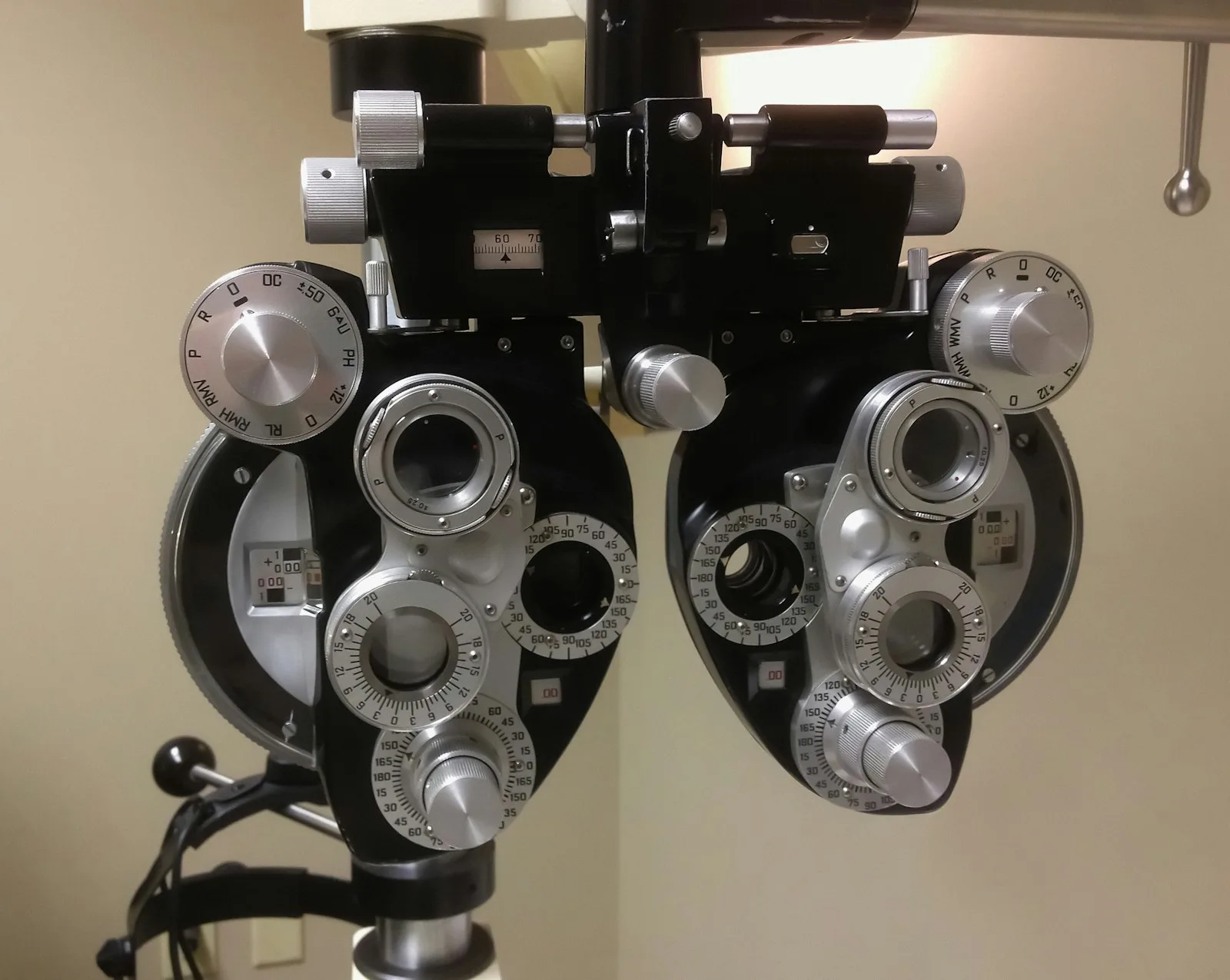
An ophthalmic prescription has several columns, one for each eye (RE = right eye, LE = left eye), and up to four parameters expressed in diopters or in degrees. Knowing how to decode these lines avoids any confusion at the optician’s.
The sphere (S): the main power
The sphere, noted “S” or “SPH”, is the main correction, the one that represents myopia or hyperopia. A negative figure (−1.50 D) indicates myopia; a positive figure (+2.00 D) indicates hyperopia. The sphere can also be zero if the correction relates solely to the cylinder.
The cylinder (C) and the axis: the astigmatic component
The cylinder, noted “C” or “CYL”, measures the intensity of astigmatism in diopters. It can be negative or positive depending on the convention used by the ophthalmologist (both notations are equivalent once converted). The axis, expressed in degrees from 0° to 180°, indicates the orientation of the cornea’s principal meridian. These two values always go together: a cylinder without an axis cannot be ground into a lens.
A concrete example: a prescription reading LE: −2.50 / −1.25 × 170° means that the left eye is myopic by −2.50 diopters, with an astigmatism of −1.25 diopter oriented at 170°. This is the most common correction of astigmatism: a cornea that curves slightly differently along its meridians.
The addition (Add): the correction for presbyopia
The addition, noted “Add” or “ADD”, is a positive extra power added to compensate for the loss of accommodation associated with presbyopia. It is common to both eyes and is expressed in positive diopters, generally from +0.75 D to +3.50 D. An addition of +2.00 D, for example, is typical of a patient aged 55 to 60. It is added to the existing spherical correction for near vision only, hence progressive or bifocal lenses.
VISUAL DEFECTS

Diopters and visual defects: myopia, hyperopia, astigmatism
The sign and the value in diopters make it possible to identify the type of refractive error and to gauge its severity. Here is what the figures actually mean for the most common defects.
Myopia: negative values
Myopia shows up as a negative sphere: −0.50 D marks the onset, −3.00 D a moderate myopia, and beyond −6.00 D we speak of high myopia. The image of a distant object forms in front of the retina, which blurs distance vision. The corrective lens is divergent (thinner in the centre than at the edge), hence the negative sign.
- Low myopia: up to −3.00 D. Moderate difficulty when driving, reading a board or road signs.
- Moderate myopia: from −3.00 D to −6.00 D. Marked distance blur without correction.
- High myopia: beyond −6.00 D. Regular retinal monitoring is recommended because of an increased risk of complications.
Hyperopia: positive values
Hyperopia gives a positive sphere. The eyeball is slightly too short, and the image forms behind the retina. Young adults often compensate through accommodation (contraction of the crystalline lens), which can mask the defect for years but leads to visual fatigue and headaches. A hyperopia of +1.00 D is mild; beyond +3.00 D, the difficulty becomes more obvious, particularly for reading.
Astigmatism: a matter of cylinder
Astigmatism is not read off the sphere but off the cylinder. It results from a cornea whose curvature is not perfectly spherical but slightly “oval” (like a rugby ball rather than a football). An astigmatism of −0.75 D is common and barely noticeable; from around −1.50 D, vision becomes distinctly blurred, both at distance and up close. Astigmatism is often combined with myopia or hyperopia.
INTERPRETATION
Diopters and visual acuity: two distinct measurements
A frequent confusion is to equate the number of diopters with visual acuity expressed in tenths. These two parameters measure different realities and do not convert directly into one another.
The diopter measures the corrective power required for an eye to see sharply. It is an objective figure, measured with an autorefractometer or by subjective refraction.
Tenths measure corrected visual acuity, that is, the sharpness of vision achieved with a suitable optical correction. A patient with −4.00 D can see 10/10 with their glasses. Another, with only −1.00 D, may reach only 8/10 because of amblyopia (“lazy eye”) or another retinal condition.
Key takeaway
The number of diopters does not predict final visual acuity. Two people with the same correction can see very differently. Only a full ophthalmic examination — including measurement of acuity with and without correction — makes it possible to assess visual quality precisely.
SURGERY
The diopter and refractive surgery: treatable ranges and choice of technique
Refractive surgery aims to correct, in whole or in part, the refractive error measured in diopters in order to reduce dependence on glasses and contact lenses. The technique chosen depends on the number of diopters to be corrected, the shape of the cornea and several other criteria assessed during the pre-operative work-up.
Laser techniques: LASIK, PRK, SMILE
Excimer lasers (LASIK, PRK/Trans-PRK) and the lenticule laser (SMILE) reshape the cornea to alter its curvature and therefore its power in diopters. The accessible range depends mainly on the available corneal thickness, because each diopter corrected consumes a certain amount of corneal tissue. As a general rule:
- LASIK and PRK commonly treat myopia up to −8 to −10 D, hyperopia up to +4 to +5 D and astigmatism up to ±5 D, provided the cornea is thick enough.
- SMILE mainly targets myopia and myopic astigmatism within similar ranges.
- These values are indicative: the final decision always rests on corneal topography and pachymetry (thickness measurement), not on the diopters alone.
The phakic implant (ICL) for high refractive errors
When the correction exceeds the limits of the laser — or when the cornea is too thin for ablation to be feasible — the phakic implant (ICL/IPCL) is frequently considered. This implantable lens is placed inside the eye, in front of the natural crystalline lens. It can correct myopia up to around −18 D and hyperopia up to around +10 D, with great precision even for high refractive errors.
The golden rule: the pre-operative work-up determines eligibility
There is no universal diopter threshold that would automatically trigger eligibility for one technique or another. The indication is always established on a case-by-case basis, during a full pre-operative work-up including corneal topography, pachymetry, pupillometry and measurement of the anterior chamber. The number of diopters is just one parameter among others. The fees for each technique are detailed on the refractive surgery pricing page.
FREQUENTLY ASKED QUESTIONS
Learn more
- Astigmatism
- Being hyperopic
- Myopia
- Visual acuity
- Combining several defects
- The anatomy of the eye
Frequently asked questions about diopters
How many diopters do you need to be myopic?
We speak of myopia as soon as a negative correction appears, even a slight one such as −0.50 D. There is no official minimum threshold: from any negative spherical value on the prescription, the eye is considered myopic. How much this affects daily life then depends on the number of diopters and on corrected visual quality.
−2 diopters, is that a lot?
A myopia of −2.00 D is considered low to moderate. It causes noticeable distance blur — driving, television, boards — but leaves good near vision without correction. It is a common value, well managed with glasses, contact lenses or, after a work-up, refractive surgery.
Diopters and 10/10: what is the link?
No direct link: these are two independent measurements. The diopter quantifies the corrective power required — an objective refractive figure. Tenths measure the visual acuity achieved once corrected — a functional figure. You can have −6.00 D and see 10/10 with your glasses, or −1.00 D and see only 7/10 because of amblyopia.
Can a myopia of −8 diopters be operated on?
A myopia of −8.00 D is operable in many cases, but the technique depends on corneal thickness. If the cornea allows it, LASIK or PRK may be considered. If it is too thin for safe ablation, the phakic implant (ICL) is often preferred. Only the pre-operative work-up can decide.
What is the spherical equivalent?
The spherical equivalent (SE) is a summary value that combines the sphere and half the cylinder: SE = sphere + (cylinder ÷ 2). It is used in particular to compare corrections of different natures or to estimate the overall severity of the defect. For example, a prescription of −2.00 / −1.00 × 90° gives an SE of −2.50 D.
Do diopters change with age?
Myopia tends to stabilise in young adults, generally around the age of 20–25. Presbyopia, on the other hand, appears around the age of 45 and adds a growing positive addition (from +0.75 D to around +3.50 D at 65). Other factors can shift the refraction: early cataract, diabetes or pregnancy. Regular ophthalmic check-ups make it possible to adapt the correction to these changes.
My prescription shows a negative figure: am I necessarily myopic?
A negative sphere does indeed mean that you are myopic: the image forms in front of the retina and the divergent corrective lens compensates for this offset. A positive sphere indicates hyperopia. The cylinder, whether positive or negative depending on the convention, only tells you about astigmatism and not about myopia or hyperopia.
Sources
- French Society of Ophthalmology (SFO) — Annual report on refractive errors and optical correction: definitions of the diopter, refractive defects and their management.
- College of University Ophthalmologists of France (COUF) — Item “Refractive disorders”: myopia, hyperopia, astigmatism, presbyopia and their corrections.
- French National Authority for Health (HAS) — Recommendations on corneal laser refractive surgery and its clinical indications.
- Atchison DA, Smith G. Optics of the Human Eye. Butterworth-Heinemann, 2000 — international academic reference on refraction and optical units.
This article is intended for information purposes and does not replace a medical consultation. Only an ophthalmic examination can precisely measure your correction in diopters, establish a personalised diagnosis and discuss the correction options suited to your situation.
Need a precise assessment of your correction?
Dr Moïse Tourabaly, former chief clinical fellow at the Quinze-Vingts hospital, measures your refraction, interprets your prescription and advises you on the most suitable solutions — glasses, contact lenses or refractive surgery.
Written and reviewed by Dr Moïse Tourabaly, ophthalmic refractive surgeon — former chief resident (Quinze-Vingts National Eye Hospital).
Last updated: July 8, 2026