Dry eye and screens: understanding, recognizing and relieving it
Stinging at the end of the day, a gritty sensation, vision that blurs in front of the computer: screen-related dry eye has become one of the most common reasons for an ophthalmology consultation. This article helps you understand the mechanism, identify your symptoms and put in place concrete solutions, supported by current scientific evidence.
UNDERSTANDING
Understanding screen-related dry eye
Dry eye is defined by the international TFOS DEWS II consensus as a multifactorial disease of the ocular surface, characterized by a loss of tear film homeostasis and accompanied by ocular symptoms (Craig et al., The Ocular Surface, 2017). Three main mechanisms come into play when you stare at a screen.
Blinking decreases. Under normal conditions, we blink roughly 15 to 20 times per minute. In front of a screen, this rate drops sharply, sometimes by half, and blinks often become incomplete. Yet each complete blink has two essential functions: spreading the tear film across the cornea, and expressing the lipid contents of the Meibomian glands located in the eyelid margins.
The tear film evaporates faster. The lipid layer, produced by the Meibomian glands, is what keeps the tears from evaporating. When it is insufficient or of poor quality, we speak of Meibomian gland dysfunction (MGD), the dominant mechanism in evaporative dry eye (Bron et al., The Ocular Surface, 2017).
A fixed gaze and the environment worsen evaporation. Heating, air conditioning, dry air, a screen positioned too high that widens the palpebral fissure: all these factors accelerate the destabilization of the tear film. This is what is referred to as computer vision syndrome or digital eye strain (Sheppard & Wolffsohn, BMJ Open Ophthalmology, 2018).

SYMPTOMS
Recognizing the signs: am I affected?
Symptoms often appear at the end of the day and ease over the weekend. You may experience:
- A gritty, sandy or burning sensation in the eye
- Stinging, itching, redness of the eyelids or conjunctiva
- Intermittent blurred vision that improves after a blink
- Paradoxical watering: the dry eye reflexively triggers a watery tear that is not very effective
- Visual fatigue, frontal headaches at the end of the day
- Increased sensitivity to light or wind
- Difficulty wearing contact lenses beyond a few hours
- Heavy eyelids on waking, crusts or secretions along the lash line
If several of these signs have affected you for more than a few weeks, a consultation is warranted to characterize the type of dryness and tailor the treatment.
Why does teleworking make the problem worse?
Several factors specific to working from home add up. Days of video conferencing extend continuous screen time, often without the natural breaks of an open-plan office (walking around, in-person meetings, hallway chats). Home workstations are rarely ergonomic: a laptop screen set too low, poorly directed lighting, no second monitor, a reading distance that is too short.
Surveys conducted since teleworking became widespread have confirmed a marked increase in symptoms of digital eye strain and dry eye among heavy screen users, particularly beyond four continuous hours a day (Sheppard & Wolffsohn, BMJ Open Ophthalmology, 2018). On top of this comes, in winter, the dry air from heating, and in summer, direct air conditioning. Postmenopausal women, contact lens wearers and people treated with certain medications (antihistamines, antidepressants, isotretinoin) are more exposed (Stapleton et al., The Ocular Surface, 2017).
DIAGNOSIS
Diagnosis during the consultation
Assessing dry eye follows a structured approach recommended by the TFOS DEWS II consensus (Wolffsohn et al., The Ocular Surface, 2017). In consultation, I use several complementary tools.
The OSDI questionnaire (Ocular Surface Disease Index) scores functional discomfort out of 100 points and allows progress under treatment to be tracked.
Tear film break-up time (BUT) measures, at the slit lamp with fluorescein, the time it takes for the film to destabilize after a blink. A BUT below 10 seconds points toward evaporative dry eye.
The Schirmer test quantifies the aqueous production of tears using a graduated strip placed in the conjunctival cul-de-sac.
Examination of the eyelid margins and meibography make it possible to assess Meibomian gland dysfunction: the appearance of the openings, the quality of the expressed meibum, glandular atrophy visible on infrared imaging.
Vital staining (fluorescein, lissamine green) looks for epithelial lesions of the cornea and conjunctiva.
This assessment distinguishes the two main mechanisms: aqueous-deficient dry eye (a deficit in production) and evaporative dry eye (MGD, the dominant mechanism in screen users). An appropriate treatment follows from this characterization.
Treatment options
Eyelid hygiene and warmth
This is the foundation of MGD treatment, to be carried out daily. A warm compress held in place for 5 to 10 minutes (40-42 °C, a reusable heated mask) softens the lipid plugs. Gentle massage of the eyelid margin from the nose toward the temple helps express the meibum. Cleaning with a dedicated pH-neutral solution removes the debris and flora that colonize the lashes. This routine, correctly prescribed and explained, lastingly improves comfort in a large majority of cases (Jones et al., The Ocular Surface, 2017).
Artificial tears: how to choose?
Not all artificial tears are equal. The principles:
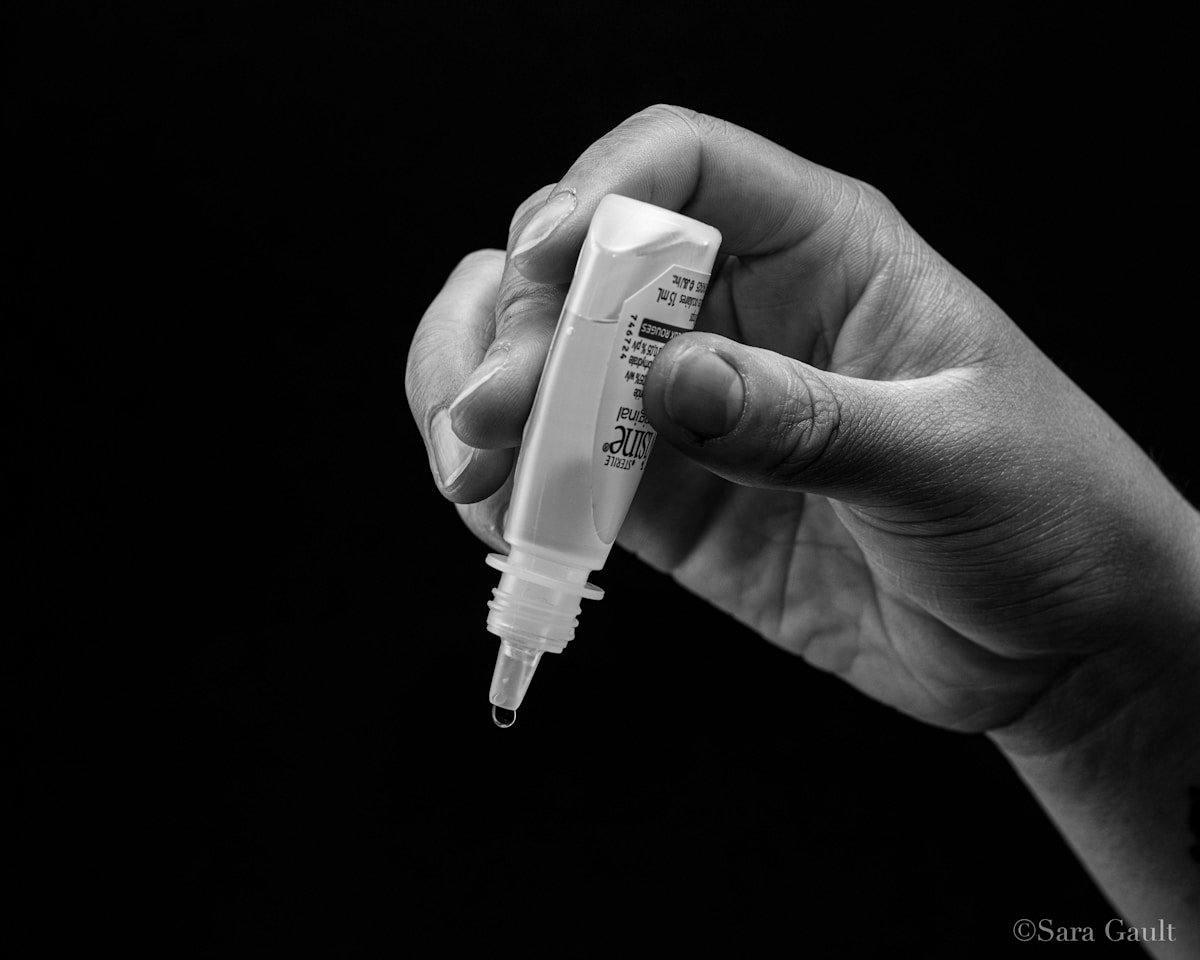
- Favor preservative-free single-dose units if you instill more than 4 times a day. Benzalkonium chloride, the traditional preservative, is itself toxic to the ocular surface with prolonged use.
- Choose the composition according to the mechanism: hyaluronic acid tears for aqueous-deficient dry eye, tears with a lipid phase (drops containing phospholipids or oil-based emulsions) for evaporative dry eye.
- Match the viscosity to the severity and the time of day: more viscous gels for the night, fluid solutions for the daytime.
Instillation should be done before discomfort appears, not after. A preventive instillation before a long video conference often provides more lasting comfort than emergency use at the end of the day.
Targeted treatments
When eyelid hygiene and tears are not enough, several options exist:
- Ciclosporin 0.1% eye drops: an immunomodulator prescribed in severe dry eye with an inflammatory component, as a maintenance treatment over several months.
- IPL (intense pulsed light): sessions carried out in the office, targeting eyelid inflammation and stimulating the Meibomian glands. Indicated in resistant MGD.
- LipiFlow / thermal pulsation: a technique of mechanical expression of the Meibomian glands under controlled heat.
- Punctal plugs: micro-plugs placed in the lacrimal puncta to slow the drainage of tears, in aqueous-deficient dry eye.
- Autologous serum: eye drops prepared from the patient’s blood, reserved for severe cases.
The choice of treatment depends on the identified mechanism and the severity. None of these treatments is trivial: all require a prescription and follow-up.
When to seek care without delay?
If the discomfort becomes daily, if it disrupts work or reading, if it is accompanied by a drop in vision, do not wait several months. Untreated dry eye can progress to superficial keratitis, recurrent corneal erosions and lastingly impair the optical quality of the cornea.
My 5 practical tips for the office
- The 20-20-20 rule: every 20 minutes, look at something 20 feet (6 meters) away for 20 seconds. This simple reminder restores a complete blink and relaxes accommodation.
- Position the screen 10 to 20 cm below eye level. A slightly downward gaze reduces the ocular surface exposed to the air and decreases tear evaporation.
- Add moisture to the room. A humidifier in winter, and avoiding an air-conditioning flow directed at the face in summer, make a real difference.
- Stay hydrated. Adequate systemic hydration (1.5 to 2 liters of water a day) supports tear production.
- Practice blink breaks. Several times an hour, close your eyes tightly for 2 seconds, then blink 5 times slowly. This exercise mechanically expresses the Meibomian glands.
If you wear contact lenses, alternate with your glasses on days of prolonged screen use. Lenses often worsen dryness by disrupting the stability of the tear film.
TREATMENT
Dry eye and refractive surgery: what you need to know
Dry eye is one of the determining factors in the choice of refractive surgery. LASIK, which creates a corneal flap, transiently severs corneal nerve endings and can increase pre-existing dryness, especially in the first few months. Moderate to severe dry eye is therefore a relative contraindication to LASIK.
This does not mean that refractive surgery is off-limits to you: other techniques (PRK, SMILE, phakic implants) can be discussed depending on your profile. This is precisely the purpose of the preoperative assessment, which systematically evaluates the quality of the tear film before any surgical proposal. Dryness that is identified and treated several weeks before the procedure significantly improves postoperative comfort.
When to seek emergency care?
Certain signs warrant a prompt consultation, without waiting for the usual appointment:
- A sudden drop in visual acuity
- Intense eye pain
- Marked photophobia (inability to tolerate light)
- A red eye with purulent secretions
- A persistent foreign-body sensation after rinsing
These signs may suggest keratitis, a corneal erosion or an infection, which go beyond simple dryness.
FAQ
Frequently asked questions
Do screens damage my eyes in the long term?
Screens do not cause structural damage to the retina or the lens in a healthy adult. However, they promote chronic dry eye and functional disturbances (fatigue, intermittent blurred vision) that can affect quality of life. Ophthalmological care helps prevent progression toward corneal damage.
Do blue-light glasses protect against dry eye?
Glasses that filter blue light have been the subject of scientific reviews that have not demonstrated a clear benefit on visual fatigue or dry eye. Blue light is not the main mechanism involved. It is better to invest in good ergonomics and regular breaks.
How long does it take to relieve dry eye?
With a well-conducted routine (eyelid hygiene, suitable tears, ergonomics), clear improvement is expected within 4 to 8 weeks. Forms linked to established MGD require a longer maintenance treatment, sometimes several months.
Do homemade saltwater drops work?
No. Saline solution in an opened bottle becomes contaminated quickly, and homemade preparations do not reproduce the complex composition of the tear film. Prefer preservative-free single-dose artificial tears, designed for the ocular surface.
My eyes water: isn’t that the opposite of dryness?
No, it is actually a common sign of dryness. When the eye is irritated by an unstable tear film, it triggers reflex watering, rich in water but poor in lipids and mucins, which evaporates just as quickly. Treating the dryness makes the watering disappear.
If I have dry eye, can I still consider LASIK?
It depends on the severity. Mild, well-controlled dry eye is not an absolute contraindication to LASIK. Moderate to severe dry eye points instead toward PRK or SMILE, or even a phakic implant depending on your correction. The preoperative assessment settles this question with objective examinations.
Should I see an ophthalmologist or my general practitioner first?
For chronic dry eye, the ophthalmologist has the diagnostic tools to characterize the mechanism (BUT, Schirmer, meibography) and tailor the treatment. A direct ophthalmology consultation allows a targeted diagnosis and a suitable treatment from the very first visit.
Scientific sources
- Craig JP et al. TFOS DEWS II Definition and Classification Report. The Ocular Surface, 2017. PMID 28736337 — PubMed
- Stapleton F et al. TFOS DEWS II Epidemiology Report. The Ocular Surface, 2017. PMID 28736338 — PubMed
- Bron AJ et al. TFOS DEWS II Pathophysiology Report. The Ocular Surface, 2017. PMID 28736340 — PubMed
- Wolffsohn JS et al. TFOS DEWS II Diagnostic Methodology Report. The Ocular Surface, 2017. PMID 28736342 — PubMed
- Jones L et al. TFOS DEWS II Management and Therapy Report. The Ocular Surface, 2017. PMID 28736343 — PubMed
- Sheppard AL, Wolffsohn JS. Digital eye strain: prevalence, measurement and amelioration. BMJ Open Ophthalmology, 2018. PMID 29963645 — PubMed
Further reading
- Preoperative assessment and dry eye — if you are considering refractive surgery
- LASIK: who is it for? — if dry eye is severe, LASIK is not the first-line option
- Book an appointment — at the Cachan office, or by phone on 01 45 47 08 11
Cachan office · Tel. 01 45 47 08 11
Disclaimer
This article is for informational purposes. A personalized ophthalmological opinion remains essential for any therapeutic decision.
Further reading: Spring eye allergy: recognizing and relieving it, another common cause of ocular surface discomfort.
Written and reviewed by Dr Moïse Tourabaly, ophthalmic refractive surgeon — former chief resident (Quinze-Vingts National Eye Hospital).
Last updated: July 6, 2026