Dry AMD: OCT monitoring and practical advice
Dry AMD progresses slowly and is not treated with injections, but it must be monitored closely so that its shift toward the wet form is not missed. The key comes down to two words: consistency and self-monitoring. Follow-up with OCT at appropriate intervals, an Amsler grid at home and a few protective lifestyle habits help preserve central vision over the long term. Here is a clear guide to understanding this disease and knowing how to act.
Direct answer: monitor regularly, act quickly if anything changes
Key points. Dry AMD (also called atrophic AMD) accounts for roughly 80% of cases of age-related macular degeneration. It progresses slowly and has no curative treatment, but it can turn into the wet form, which is treated urgently with injections. Monitoring relies on macular OCT, generally every 6 to 12 months depending on the stage, supplemented by self-monitoring with the Amsler grid. On the prevention side, AREDS2-type supplements, quitting smoking, sun protection and a diet rich in green vegetables and omega-3s are the best-documented measures.
What is dry AMD?
Age-related macular degeneration (AMD) is the leading cause of low vision after age 50 in industrialized countries. It affects the macula, the central area of the retina responsible for fine vision and detail. The dry form, known as atrophic, accounts for roughly 80% of cases. It is characterized by a progressive breakdown of the cells of the macula, with the appearance of deposits called drusen and then, at an advanced stage, patches of atrophy. The result is a slow, gradual decline in central vision, while peripheral vision remains preserved.
Dry or wet AMD: why the distinction matters
- Dry AMD: slow progression, no curative treatment to date, management based on monitoring and prevention.
- Wet AMD: rapid progression linked to neovessels, treated urgently with intravitreal anti-VEGF injections.
- The essential point: dry AMD can turn into the wet form. That is the whole purpose of monitoring: to spot this shift as early as possible, because early treatment of the wet form better protects vision.
Monitoring with OCT
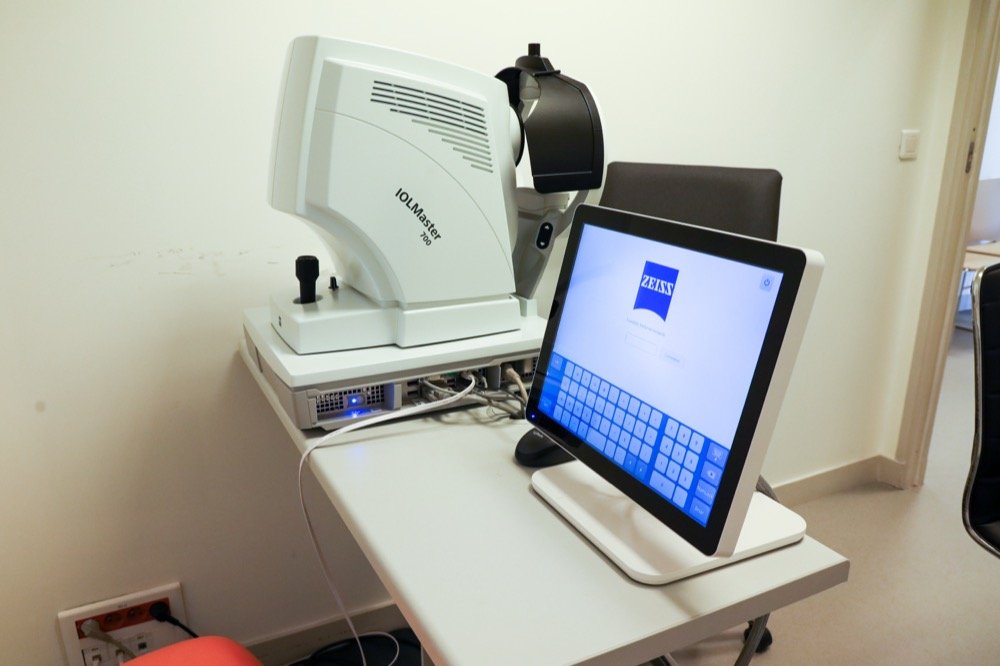
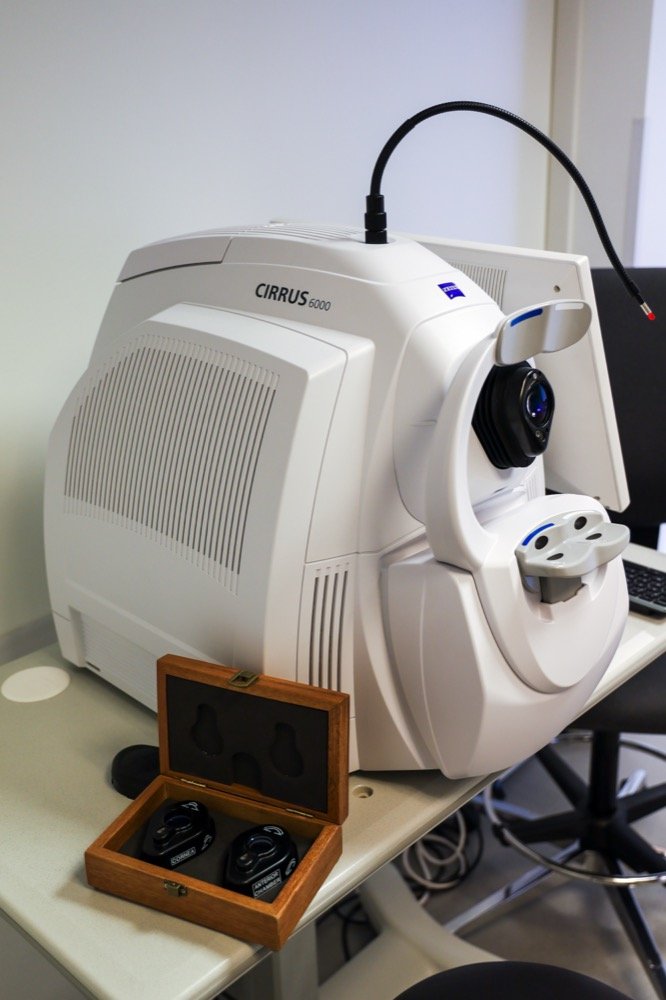
Macular OCT (optical coherence tomography) is the key examination for follow-up. Painless and contact-free, it provides a cross-sectional image of the retina and makes it possible to measure the thickness of the macula, track the progression of drusen and atrophy, and above all detect early any conversion to the wet form thanks to the presence of fluid beneath the retina. The follow-up rhythm depends on the stage: in practice, an OCT every 6 to 12 months is often proposed, to be adjusted according to the signs. This monitoring takes place at the practice, using a latest-generation OCT.
Self-monitoring with the Amsler grid
Between appointments, self-monitoring is valuable. The Amsler grid is a pattern of squares that you look at one eye at a time, at reading distance and with your usual glasses. If the lines appear distorted or wavy, or if a dark spot appears in the center, you should seek care quickly: these signs may reflect a shift toward the wet form, where early treatment matters a great deal. This simple monitoring, done regularly at home, complements OCT without replacing it.
Prevention and dietary supplements
- AREDS2 supplements: the AREDS2 study and the reviews that followed showed that a formula combining lutein, zeaxanthin, vitamins C and E and zinc can slow the progression of AMD in patients at an intermediate or advanced stage in one eye. It does not prevent the onset of the disease and is prescribed after medical advice.
- Quitting smoking: smoking is one of the best-established modifiable risk factors for AMD, increasing the risk roughly two- to fourfold depending on the study. Quitting is the most useful preventive measure.
- Sun protection: sunglasses that filter UV and blue light during prolonged exposure.
- Diet: a diet rich in leafy green vegetables (spinach, kale) and oily fish (omega-3s) is part of a lifestyle favorable to the retina.
FAQ
Frequently asked questions
Can dry AMD be cured?
There is no curative treatment for dry AMD to date. Management relies on regular monitoring to detect a shift toward the wet form, and on preventive measures such as AREDS2 supplements, quitting smoking and a healthy lifestyle.
How often should an OCT be done?
The rhythm depends on the stage of the disease. In practice, a macular OCT every 6 to 12 months is often proposed, to be adjusted according to progression and signs. Your ophthalmologist will specify the interval that suits you.
When should I seek urgent care?
If, while looking at the Amsler grid, the lines appear distorted or wavy to you, or if a dark spot appears in the center of your vision, seek care quickly. These signs may reflect a shift toward the wet form, which is treated all the better when caught early.
Do AREDS2 supplements prevent AMD?
No. They do not prevent the onset of the disease. They can, however, slow progression in some patients who are already affected, at an intermediate or advanced stage in one eye. They are taken on medical advice.
Does smoking really worsen AMD?
Yes. Smoking is one of the best-established modifiable risk factors for AMD, with a risk increased roughly two- to fourfold depending on the study. Quitting smoking is the most effective preventive measure.
Does AMD cause blindness?
AMD affects central vision but spares peripheral vision: it does not lead to complete blindness. It can, however, strongly interfere with reading and recognizing faces. Appropriate monitoring helps preserve visual independence.
Scientific sources
- Age-Related Eye Disease Study 2 (AREDS2) Research Group. Lutein + zeaxanthin and omega-3 fatty acids for age-related macular degeneration: the AREDS2 randomized clinical trial. JAMA. 2013;309(19):2005-2015. PMID 23644932.
- Evans JR, Lawrenson JG. Antioxidant vitamin and mineral supplements for slowing the progression of age-related macular degeneration. Cochrane Database Syst Rev. 2023;9(9):CD000254. PMID 37702300.
- Thornton J, Edwards R, Mitchell P, et al. Smoking and age-related macular degeneration: a review of association. Eye (Lond). 2005;19(9):935-944. PMID 16151432.
- Identification of risk factors for the progression of age-related macular degeneration: a systematic review and meta-analysis of cohort studies. Front Med (Lausanne). 2025. PMID 40771483.
Further reading
AMD follow-up with OCT in Cachan and Paris 13 · Tel. 01 45 47 08 11
Have your AMD followed by an ophthalmologist
Well-monitored dry AMD can be lived with under good conditions. To set up OCT follow-up tailored to your situation and review prevention, book an appointment with Dr Moïse Tourabaly, who consults in Cachan and Paris 13.
This article is intended for information and educational purposes. It does not replace a medical consultation. The follow-up and prevention of AMD must be adapted by your ophthalmologist. Sources: articles indexed on PubMed.
Written and reviewed by Dr Moïse Tourabaly, ophthalmic refractive surgeon — former chief resident (Quinze-Vingts National Eye Hospital).
Last updated: July 6, 2026