Cataracts and night halos: what the EDOF implant changes
Light halos at night are among the main concerns after cataract surgery. Long associated with conventional diffractive multifocal implants, they can now be limited by EDOF (Extended Depth of Focus) implants, a new generation of optics that broadens the depth of field without producing the same nighttime artifacts.
Basculez d'un implant à l'autre. Les scènes nettes correspondent aux distances vues sans lunettes ; les scènes floues à un appoint lunettes souvent utile.
Multifocal : des halos peuvent être perçus la nuit en vision de loin ; la lecture de près est plus confortable avec un bon éclairage.
Le choix de l'implant dépend de votre œil et de votre mode de vie ; il se décide avec le chirurgien.
UNDERSTANDING
Understanding night halos after cataracts
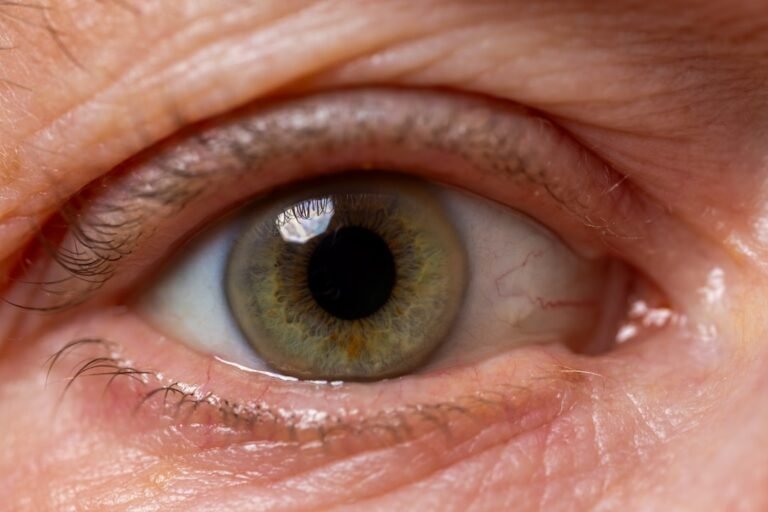
Light halos are an example of positive dysphotopsia: the perception of concentric rings around bright light sources (car headlights, illuminated signs, street lamps). Their origin is optical: the intraocular implant diffracts light into several focal points to restore vision at different distances. This distribution of light energy can generate artifacts, particularly visible at night when the pupil is dilated.
According to Corbett et al. (Eye, 2024), non-diffractive EDOF implants cause noticeably fewer halos and glare at night than previous-generation multifocal implants, for a large majority of patients, while offering an extended range of sharp vision. In practical terms, this means more comfortable night driving: reflections around headlights and illuminated signs are reduced, and reading the GPS or the dashboard remains pleasant. The experience nonetheless varies depending on pupil profiles and visual habits.
The intensity of the light halo after cataract surgery depends above all on the type of implant chosen. This phenomenon is mainly linked to multifocal implants, and trifocals in particular, whose optics distribute light across several focal points; the latest-generation models have markedly reduced it. With an EDOF implant, halos are far more discreet, and they are almost absent with a monofocal implant, which does not split the light — at the cost, however, of a correction limited to a single distance. In a person affected by cataracts, the clouded lens scatters light and heightens light sensitivity as well as the halos perceived around lights ; replacing it with a clear artificial lens most often restores normal everyday activities and reduces the wearing of glasses.
WHO IS AFFECTED
Who is affected by these halos?
Night halos primarily affect certain situations:
- Night drivers (professionals, long journeys)
- Night-time or shift-work occupations
- Artists, photographers, screen workers in low light
- Patients fitted with older-generation diffractive multifocal optics
- Patients with large scotopic pupils (> 5 mm in low light)
A preoperative questionnaire on visual habits together with an examination of pupil dynamics helps identify the highest-risk profiles and guide the choice of implant accordingly.
SOLUTIONS
The solutions: the EDOF implant
EDOF (Extended Depth of Focus) implants extend the depth of field rather than creating several distinct focal points. Two main technologies exist:
- Vivity (Alcon): a non-diffractive EDOF using wavefront-shaping technology. Its modified optical profile extends the depth of field while strongly limiting night halos, close to those of a monofocal implant. Continuous vision from far to intermediate, with glasses often useful for fine reading.
- Pure See (Johnson & Johnson, TECNIS PureSee™ range): a latest-generation refractive EDOF. It offers an extended range of vision from far to intermediate, with a halo profile very close to that of a standard monofocal implant: an asset for night drivers and screen workers.
- Earlier diffractive EDOF (Symfony, TECNIS Eyhance): improved intermediate vision with a diffractive profile optimized to limit halos compared with conventional trifocals.
A study published by Georgiev et al. (JCRS, 2020) involving patients switched to a bilateral toric EDOF implant showed a clear reduction in bothersome halos and glare, high patient satisfaction and a more occasional need for glasses at far and intermediate distances. It remains important to remember that EDOF does not fully replace fine reading: patients who are very demanding about reading small print may need glasses for small characters.
To learn more about the available techniques and implants, see the cataract surgery page or the details of premium implants.
PATHWAY
The care pathway
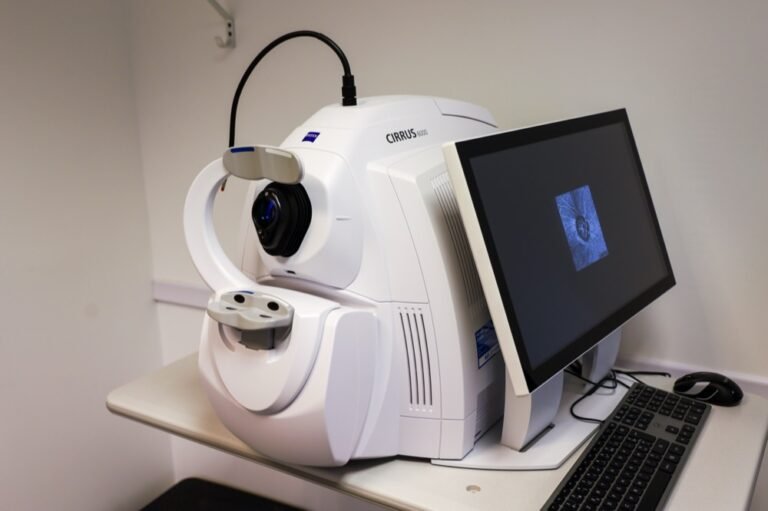
Dr Tourabaly sees patients at the Cachan (94) practice and in Paris 13 for the preoperative cataract assessment. The work-up includes optical biometry (IOL Master), corneal topography, a macular OCT and an examination of pupil dynamics. These examinations determine the choice between a monofocal implant, an EDOF or a multifocal.
Surgery is performed at the Clinique Sainte-Geneviève (Paris 14), in a dedicated operating facility. The two eyes are operated 2 to 4 weeks apart depending on visual stability. To make an appointment, call the practice at 01 45 47 08 11 or via Doctolib.
Dr Tourabaly’s view
“An EDOF implant is not indicated for every patient. For those who drive a lot at night, I generally prefer to offer a non-diffractive EDOF rather than a multifocal. Conversely, for someone whose main goal is complete independence from glasses and who tolerates halos well, the trifocal remains a suitable option. The time devoted to this discussion before surgery greatly changes the perceived outcome.”
FAQ
Frequently asked questions
Discuss your implant choice with Dr Tourabaly
Sources
- Corbett D, Black D, Roberts TV, et al. Quality of vision clinical outcomes for a new fully-refractive extended depth of focus intraocular lens. Eye (Lond). 2024;38(10):1815-1820. PMID 38580741
- Georgiev S, Palkovits S, Hirnschall N, et al. Visual performance after bilateral toric extended depth-of-focus IOL exchange. J Cataract Refract Surg. 2020;46(12):1624-1629. PMID 33060471
This article is for informational purposes. A personalized ophthalmological opinion remains essential for any treatment decision.
Written and reviewed by Dr Moïse Tourabaly, ophthalmic refractive surgeon — former chief resident (Quinze-Vingts National Eye Hospital).
Last updated: July 6, 2026