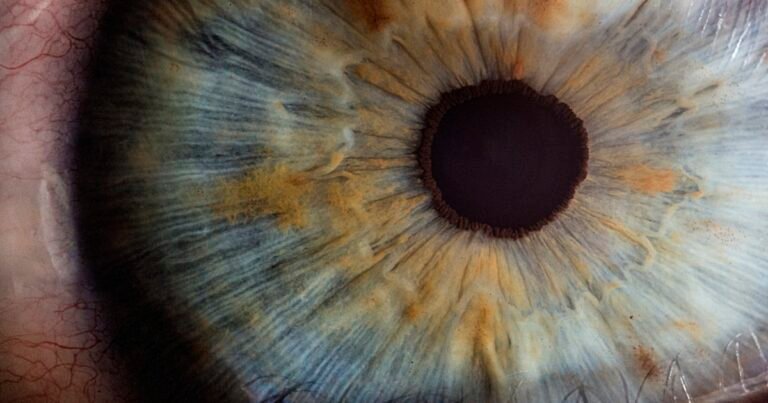
High myopia turned down for LASIK: the phakic ICL implant option
“Your myopia is too high for LASIK.” This statement surprises many patients. It does not mean giving up on a life without glasses: the phakic ICL implant (Implantable Collamer Lens) can now correct severe myopia up to -18 dioptres, reversibly and without touching the cornea.
Zoom sur le segment antérieur. Basculez l'affichage pour voir l'implant se positionner derrière l'iris, devant le cristallin conservé. Survolez une structure pour la mettre en évidence.
UNDERSTANDING
Why LASIK is not always possible
LASIK relies on reshaping the cornea with an excimer laser: the higher the myopia, the greater the amount of corneal tissue removed. Beyond -8 to -10 dioptres, the residual stroma becomes insufficient to guarantee the long-term biomechanical stability of the cornea, with an increased risk of post-LASIK ectasia.
Other situations rule out LASIK: thin pachymetry (< 480-500 µm), topography suggestive of subclinical keratoconus, severe dry eye, large scotopic pupil diameter. In these cases, corneal surgery is not a safe option and an intraocular procedure must be considered instead.
WHO IS CONCERNED
Who is a candidate for the phakic implant?
The phakic EVO ICL implant is intended for patients who meet several criteria at once:
- Age: marketing authorisation is set at 21 years, but in my practice I generally prefer to wait until at least 25 years to ensure solid refractive stability and limit the risk of residual myopic progression. The upper limit then depends on the condition of the natural lens (usually up to 45-50 years, sometimes beyond).
- Myopia from -3 to -18 dioptres, with or without astigmatism (up to -6 D with the toric version).
- Refractive stability over at least 12 months.
- Anterior chamber depth sufficient (≥ 2.8 mm, ideally ≥ 3.0 mm to optimise long-term safety).
- Endothelial cell density meeting the STAAR age-dependent chart. In practice, the thresholds are higher the younger the patient: more than 3,250 cells/mm² in patients aged 21 to 25, then decreasing thresholds down to a floor of around 2,000 cells/mm² after age 45. The clinical goal is to preserve a sufficient endothelial reserve for life.
- No glaucoma, chronic uveitis, or progressive corneal disease.
A comparative study by Cao et al. (BMC Ophthalmol, 2021) on high myopia found high efficacy and predictability for the ICL, with rapid visual recovery and a favourable safety profile at medium term compared with SMILE. A more recent meta-analysis by Kisiel and Gurumurthy (J Cataract Refract Surg, 2024) on endothelial cell loss after V4c ICL reports a moderate cumulative decrease at medium term, generally remaining compatible with a functional endothelial reserve over time — provided selection at the initial work-up is rigorous.
SOLUTIONS
The solution: the EVO Visian ICL
The EVO ICL is a soft collamer lens (a biocompatible material derived from collagen) positioned between the iris and the natural lens. Its EVO+ version features a central hole (aquaport) that facilitates the flow of aqueous humour and reduces the risk of pupillary block — eliminating the need for a prior iridotomy.
The procedure takes 15 to 20 minutes per eye, on an outpatient basis, under topical anaesthesia. The implant is inserted folded through a corneal micro-incision and then unfolds in the posterior chamber. Alonso-Juárez et al. (Clin Ophthalmol, 2022) report, in patients with moderate myopia, predictability above 90% at ±0.50 dioptre at 6 months, with uncorrected vision close to the optimal preoperative correction.
The main advantages: reversibility (the implant can be removed or replaced), complete preservation of the cornea, and high optical quality even at high dioptres. The limitations to be aware of: a rare risk of premature cataract (0.5 to 2% at 10 years depending on the series), transient postoperative ocular hypertension, and exceptionally endophthalmitis (1/3,000 to 1/5,000).
For more technical information, see the page dedicated to the EVO ICL phakic implant.
PATHWAY
The treatment pathway
The ICL-specific preoperative work-up includes: optical biometry (implant size calculation), anterior chamber depth (Scheimpflug or anterior segment OCT), white-to-white measurement, corneal topography, endothelial cell count, and a dilated fundus examination (peripheral tears are common in high myopia).
I also systematically request an UBM ultrasound (ultrasound biomicroscopy) of the anterior segment, which allows precise measurement of the sulcus-to-sulcus diameter and refines the choice of implant size. This examination, not performed directly at the practice, is referred to a colleague ophthalmologist specialising in anterior segment imaging. Its reliability is a decisive factor in preventing a vault that is too high or too low after the implant is placed.
Dr Tourabaly sees patients at the Cachan practice (94) and in Paris 13. The procedure is performed at the Clinique Sainte-Geneviève (Paris 14), in a facility dedicated to intraocular surgery. Treatment is generally bilateral: both eyes are operated on successively, most often a few days apart to limit the discomfort caused by the asymmetry of visual correction. Jiang et al. (Asia-Pac J Ophthalmol, 2024) compared immediate and delayed bilateral approaches, with similar vault and safety results in both schemes, guiding the choice according to the individual clinical situation.
To book an appointment for an ICL feasibility work-up: call the practice at 01 45 47 08 11 (Cachan) or book directly on Doctolib.
Dr Tourabaly’s view
“I regularly see very myopic patients who thought they were ‘condemned’ to wearing glasses for the rest of their lives. The ICL changes their daily life, and its reversibility is an important argument: if a cataract develops years later, the implant can be removed during the procedure. It is an option that protects the future, provided the selection criteria are strictly respected.”
FAQ
Frequently asked questions
ICL feasibility work-up with Dr Tourabaly
Sources
- Cao K, Zhang J, Wang J, et al. Implantable collamer lens versus small incision lenticule extraction for high myopia correction. BMC Ophthalmol. 2021;21(1):450. PMID 34961514
- Alonso-Juárez E, Velázquez-Villoria D. Low Diopter Phakic Implantable Collamer Lens: Refractive and Visual Outcomes. Clin Ophthalmol. 2022;16:2969-2977. PMID 36081600
- Kisiel FB, Gurumurthy GJ. Endothelial cell loss post-implantable collamer lens V4c: meta-analysis. J Cataract Refract Surg. 2024;50(4):420-423. PMID 38194352
- Jiang Y, Chen X, Cheng M, et al. Immediate versus delayed sequential bilateral ICL implantation: A retrospective comparison of vault height and outcomes. Asia-Pac J Ophthalmol (Phila). 2024;13(3):100075. PMID 38795866
This article is for informational purposes. A personalised ophthalmological opinion remains essential for any treatment decision.
Written and reviewed by Dr Moïse Tourabaly, ophthalmic refractive surgeon — former chief resident (Quinze-Vingts National Eye Hospital).
Last updated: July 6, 2026